Thursday, September 22, 2011

Sit-Rep: Tach & Antennae

July 22 (ish), 2011

This is pretty brief, but it comes in the form of a micro-rant. I hate it when car companies think that since the vehicle is automatic the driver has no regard for what the engine is doing, so they don't bother installing a tach to save space or something. This is even more prevalent in a stickshift (such as my Echo, which is standard, and has no tach... I suppose they want me to just guess?)

Because of this manufacturing gaffe, I bought an inexpensive tach for the echo years ago, but it turned out to be incompatible with the more sophisticated (though I typically like sophistication in a lot of things) ignition system. I therefore shelved it for a few years until I got around to installing it in the more archaic 70's bred Wagoneer ignition system (which as legend has it was cobbled from Ford).

This was just about as easy as that staples button. A quick self tapping screw holds the mount against the A pillar, and the wiring tucks neatly doen the side of the dash behind the weatherstripping. It then runs through the firewall to it's respective coil mount.


Next came the relocation of the radio antennae. This was also fairly easy, using a shortened section of the cable routed behind the passenger side dash (which is a completely empty cavern I might add, tucked behind the original 1963 dash steel that Jeep neve bothered to change). There is a 1/2" hole at the end of the dash where I fished the cable through, and turned it up to plug into the original exterior mount. Then I essentially just jammed it in place, with the provision that I would later secure it somehow. Note; this requires you to either cut your antennae down to about 16" or use an off the shelf shortened one. I had some of these yellow ones laying around in new packages, so I popped one open and it slotted in as a perfect fit. Now my 1 speaker radio has some matching receiver action to boot.


Saturday, August 6, 2011

Re:Mounts

June 18, 2011

Probably a good idea when looking at an old "body on frame" vehicle to give the body mounts a good forceful tug. Had I tugged mine earlier I would have caught both the 2 front body mounts, as they were only held in place by the rubber that comprises them. The bolts inside had rusted through completely, and swelled in true cauliflower style so that the once 3/8" collared bolt was now an inch around due to puckering, and was completely severed from the rest of the body. I noticed the mount itself is fairly badly rusted as well... shhhh.


I was able to cut into the floor above the mount, where a special housing held a blind nut with the remaining stud still in it. Since I could not drill this out my only option was to shear it clean from the frame rail. A little bit of punch work and some wiggling freed up the old crumbled mess of the bolt. This allowed me a clear shot through the old bodymount with a new stainless (304) bolt, with large fender washers and flange nuts.


I  Fed the whole deal back together and repeated the process on the drivers side (wish i'd noticed this before doing my floor repair initially.

Tuesday, May 10, 2011

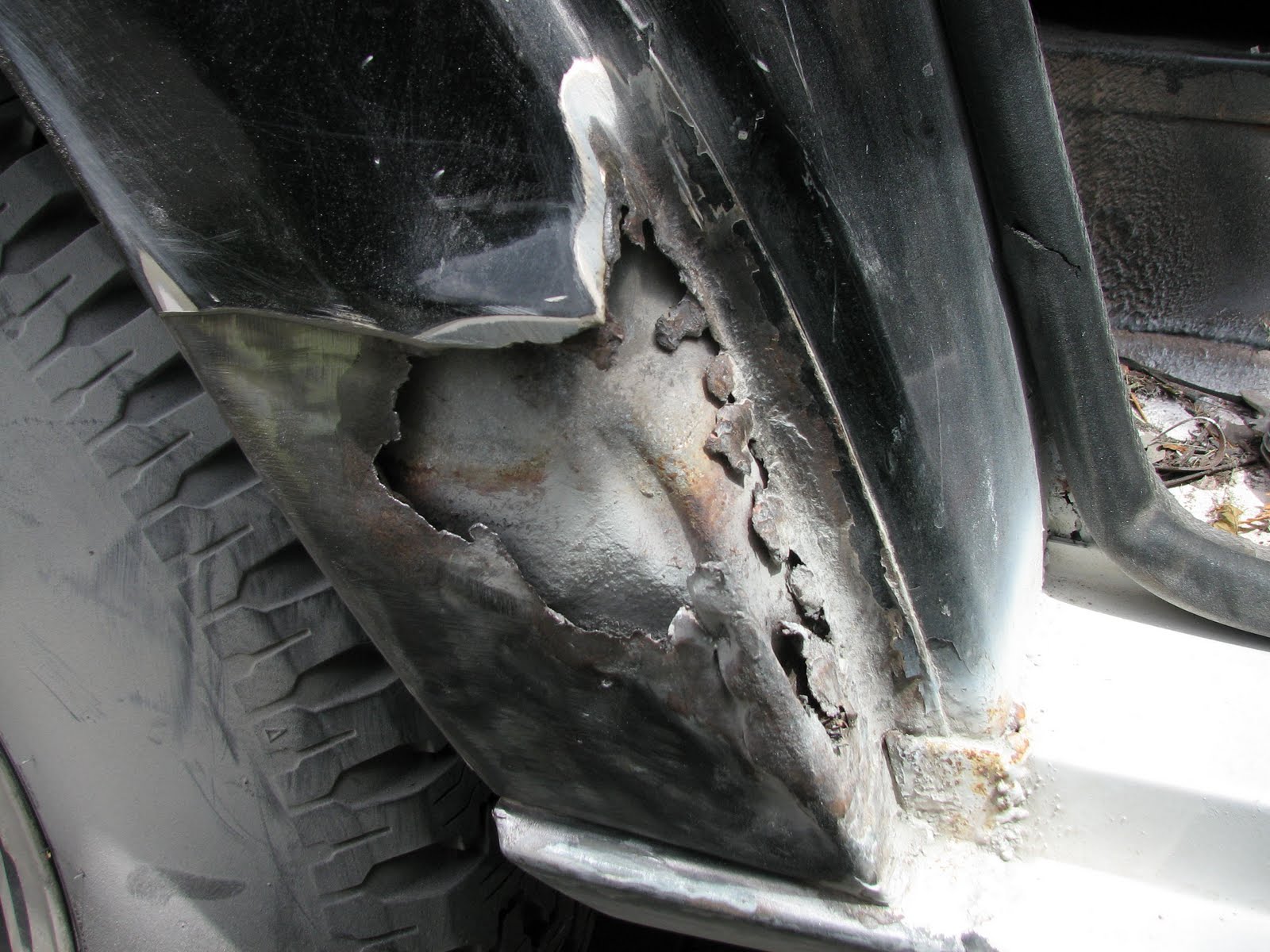
Oh Look; More Rust


May 7, 2011
 
It seems that rather predictably, someone in the past indulged their insatiable craving for hitting something and then smearing on as much Bondo as their silicone spatula would allow. 


To placate the rig’s gaping wound, I mapped out a plan to patch in some new steel and give the beast some much needed rigidity. This began with some rudimentary sharpie work, and some exploratory wire-brushing to remove a few pounds of bondo. The rather extensive rust had eaten its way through most of the lower “dog leg” section, and by the looks of things, someone had done some brazing work with some new steel years ago. I grabbed the grinder and cutoff wheel and plunged into the body, slicing back until I was able to find good thick steel. 


This angular cutout then served as the template for my new steel patch, which I decided to tackle in 2 stages; the first part being the return portion that runs back into the door opening, and the second being the visible portion of the dogleg. I regret now not treating that rust on the inner steel of the wheelwell, and will likely have to tackle that in the future. 

After mocking up the patches using thick cardstock, I duplicated the patch out of either 18 or 20 gauge steel (not sure which). I learned years ago on another patch that it is best to curve the steel around a corner instead of welding right at the corner, as it makes for a cleaner bodyline that you can use when filling. Nipping the edge into little tabs allowed me to do the required compound curves on the steel to achieve the closest match I could to original.


With the first patch in place, I focussed my attention on getting the second, more visible patch in. doing the patches in this order ensured I would get the correct bodyline from the previous patch. I made the patch slightly oversized and trimmed it for an exact fit. By tack welding the bottom in first, I was able to progressively line up the patch and tack it in, finally using a body hammer and a dolly to achieve the small angular bodyline at the top (which was difficult to replicate). Some filler should bring the correct lines back, as the rest of this small panel had been damaged and repaired before. 


Monday, April 25, 2011

Plans, Plans, Plans

In a somewhat artistic fashion, I am breaking code with my "chronological order" of things today. Since I haven't worked on the Wagoneer all winter (accounting for the lack of posting), I have devised a sketch in the warmth of my studio. I never really planned out what I wanted to accomplish with this project until quite a while into owning it, possibly because the amount of work was so foreboding that I wasnt able to get my mind past it. 

Now that all my mechanical work is complete (thanks to several days of holiday; and the subject of a subsequent blog), I am able to more or less visualize what I want the Wagon to end up being. First of all, no more woodgrain; this took only a few clicks of the mouse on the net to discover that replacement woodgrain is worth about 4 times what I paid for the truck in the first place, and I can put that money to better use.

One of the nice things about sketching is you can mock up any design you want, whenever you want. Not to sound nostalgic but I still prefer good old fashioned hand drawing over CAD programs or photo manipulating tools; it's typically faster anyways.

This overlay sketch (uses many sketches as underlays to develop the final image) is a rough depiction of my concept for the finished product, using a blend of new custom designed equipment while retaining the rugged mid 60's looks. the stripe (in vynil) denotes the engine displacement instead of using the cliched "V8" emblem, tones which are picked up by the dual exhaust and glasspack mufflers. Thinking of badging it the "Timberline" to denote the sort of rugged landscape this vehicle is built for (like the term "treeline," the timberline is typically the elevation where trees become sizeable enough to be used commercially). 

The utility rack is designed to fit the stock roof rack mounts, while following the contour of the roof and deflecting wind to hopefully aid a bit in aerodynamics; as if it mattered. Front and rear utility bumpers freshen the face from the tired sculpted aluminum ones that made it look so dated. They give it a more muscular appeal, and are far more useful than the original, integrating tow hooks, trailer hitch, winch mount points, and heavier protection.

Although the sketch is along the lines of a 4-6" lift, I will be going for something more like 2" for better road manners, and cost effectiveness. the tires are merely conceptual, but I will likely look for some aggressive tread meat once my stock tires wear out (they are currently brand new).

As an aside, I have never been a particular fan of that grille. I would like to swap in a mid 60's through mid 70's grille, as they are more durable and better looking.

Tuesday, January 25, 2011

Packin’ Glass


September 1, 2010

As with any good restoration enthusiast, it pays to have willing help that often will work for free. Having a brother-in-law close by has been a great boon to this project, as he is often more willing than I am to get his hands dirty and fix stuff. As a Pro mechanic and a master of anything pertaining to older vehicles, I enlisted his help on inspecting some exhaust parts and doing some brake line work before the weather got too cold (winter is an absolute beast; and a legendary raider of ambition)
 
               With one swift tug at the old muffler, it crumbled like a matzah; leaving a 2’ gap between my cat and the rest of the tailpipe. Replacement OEM mufflers are upwards of $50 if I’m lucky, and they really lack in character. Much to my economic benefit (though I assume more for my amusement), Canadian Tire sells a few sizes of CherryBomb Glass-Pack Mufflers. These units are made of heavier steel and are treated in heat resistant paint for longer life. They also are designed to flow straight through, boosting flow by as much as an advertised 40% - leaving the low rumble of the V8 while skimming off the higher pitch noises.


      The fit was just about stock, with the tail pipe being pulled a bit further forward. It made a difference in so many ways that it made the truck sound a lot younger. For starters, it quietened the exhaust from its old rattling hollow muffler problems, and added some much needed rumble. Since these mufflers were designed in the 60’s for muscle cars, it fits my engine like a glove.


       I also turned my attention to treating the front brakes to match my new rear drums. I popped off the rim and set to cleaning the calipre for paint. This adds nothing in terms of stopping distance, but does add a cool focal point on the road when the wheel is spinning. With the help of my brother in law, we removed the front passenger brake line and flex line, and began bending some blank stock to fit (didn’t finish, got too cold). 


Monday, January 10, 2011

Broken Glass & Other Assorted Malice

April 27 - June 15

This blog covers a great deal of time (roughly 2 months), so I'll keep it quick as possible. Although the windshield itself was brand new when I bought the Jeep, the framing below was for lack of a better word - Gone. What follows is a pictorial depiction of the reconstructive surgery the beast underwent.

This had been attempt 1 at fixing the rust, but I never liked it and felt that I could do better.

In order to fix these corners, I knew the windshield had to come out. My Haynes manual told me to leave windshields to a professional, and thus wouldn't tell me how to do it. I pressed on anyways (quite literally). i did countless hours of research, and people told me it was easy; just undo the gasket and push in the top corners with your feet. The glass will just pop right out. I even put a blanket on the hood to catch the glass when it came free.


Ugh.... they lied 

After the first break, it would be pointless to try and save it. The only way forward was to smash my way out. I did manage to save the gasket though, which of the 2, was the harder one to find.


 All this missing frame meant the new windshield would face 3 problems if I left it. a) it would let water seep in, b) it wouldn't support the windshield, and c)the installer would refuse to let me get away with it.

 Same goes here. More tricky curves, and in very noticeable areas. The other 2 corners looked much the same.

 Patch #1. it's not that I ran out of metal, the perforated metal is supposed to allow the bondo to hold better around the curve, without falling out later.

 This patch took about an hour of fitting and hammering and bending with pliers (all the proper body-working tools). Once welded in though it followed the lines well. The trick is (or for me) to be just below where the bondo surface will be so it blends better without metal sticking through.

 Sanding after first application. It's looking more complete already.

 Upper corner looking good. It looks more like a bad dent than a new patch.

 Passenger lower corner. Under that bondo is some custom formed replacement metal.

 More custom metalworking, done to AMC specs (built to the nearest foot).

 Initial primer shot. this shows low points and pitting.

 medley of primer, bondo, and more primer. Leveling out now (btw, if anyone sees anything wrong with my methods of bondo-ing, feel free to let me know).

 Shot with a sealing layer of Tremclad. I did find a few fisheyes, and the trem doesnt stick that well to red oxide primer.

 This probably turned out to be my best corner. The windshield guy didnt notice until I told him.

 Passable, but the bodyline could have been softer.

 This was a more functional fix, since most of it is now under the gasket. The paint layers sealed it before I had a new window installed.

 Open cruising concept... it is a Jeep after all.

Awaiting its new windshield.

New windshield in. It looks so fresh, and whe it's all clean you can barely tell it exists from inside. It didnt come with a mirror mount though, so I plundered a scrap field truck for a mount and a mirror.

All in all I was pleased with the results of this semi unexpected fix. It turns out that despite being a rare vehicle, a brand new windshield was less than one for a newer car (and they came and installed it in my driveway).

Tuesday, November 23, 2010

Forgotten Things and an Anniversary

Collective From Earlier in 2009

I know I haven't written in ages, but since I figure that no-one is actually reading this, I can do what I want. 

I'm breaking chronological form here to tidy up a few things I had done earlier in the project. As with any zealous blogger (not me) or totally professional auto restorer (not me again), you will religiously take pictures and sort them so you have an action by action account of your project. While I very much wanted to do this at the beginning, it's been a bit harder to remember recently as i just dive into the issue and take pictures once im done.

anyways, im noting here one of my bodywork pilot projects, which I only took finished pictures of, and some other painting stuff for my transmission.


You may recognize this as my rear right door, the one that had been plagued by such vicious rust that anyone else would have deemed it unsalvageable.  seeing as how wagoneer doors are hard to come by, I decided to take a crack at fixing it full on. I popped open the tin of paint stripper at 2:00am in the schools shop, and tried it in an inconspicuous area first. One thing I learned is that this stuff; although gell, dries really fast, before really having a chance to work on the paint. I made a deep-night dash down to the cafeteria with a classmate (nameless) who helped me snag a bunch of aluminum foil from the dispenser. industrial sized, and thicker than regular stuff, it covered the paint stripper well when I smeared it all over the door, and kept it from evapourating. The nice thing was i could use it again for the second application. once the paint was all removed I ground into the rust with no remorse, and treated it with a rust converting liquid. Note: the pictures above are a preliminary primer, thus still a bit rough.

once it was clean and roughed up, I applied some lovely glass-filled body filler (napa-brand), which has short strands of fibreglass in it to give it strength over holes. I have so far been using it on any areas that are perforated. it sands really well, and I built myself a number of sanding blocks from MDF scraps and old sanding belts. I then honed my model making skills with subsequent bondo-ing, sanding, spot puttying, etc - all the way down to primer. I was pretty pleased with the results after painting but you can see it in a certain light.

Also, I stripped the paint from my tranny pan and let a classmate use up some expensive acrylic paint he had leftover from his motorcycle he was painting (you know who you are). I prepped it with a new gasket and filter from Carquest for $20 since my old seal leaked and the filter was black.


Lastly, today (Nov 23/2010) marks the 3rd anniversary of my owning the wagoneer. Man time flies. anyways, I had thought long ago that it would be a shorter project, but such is life.